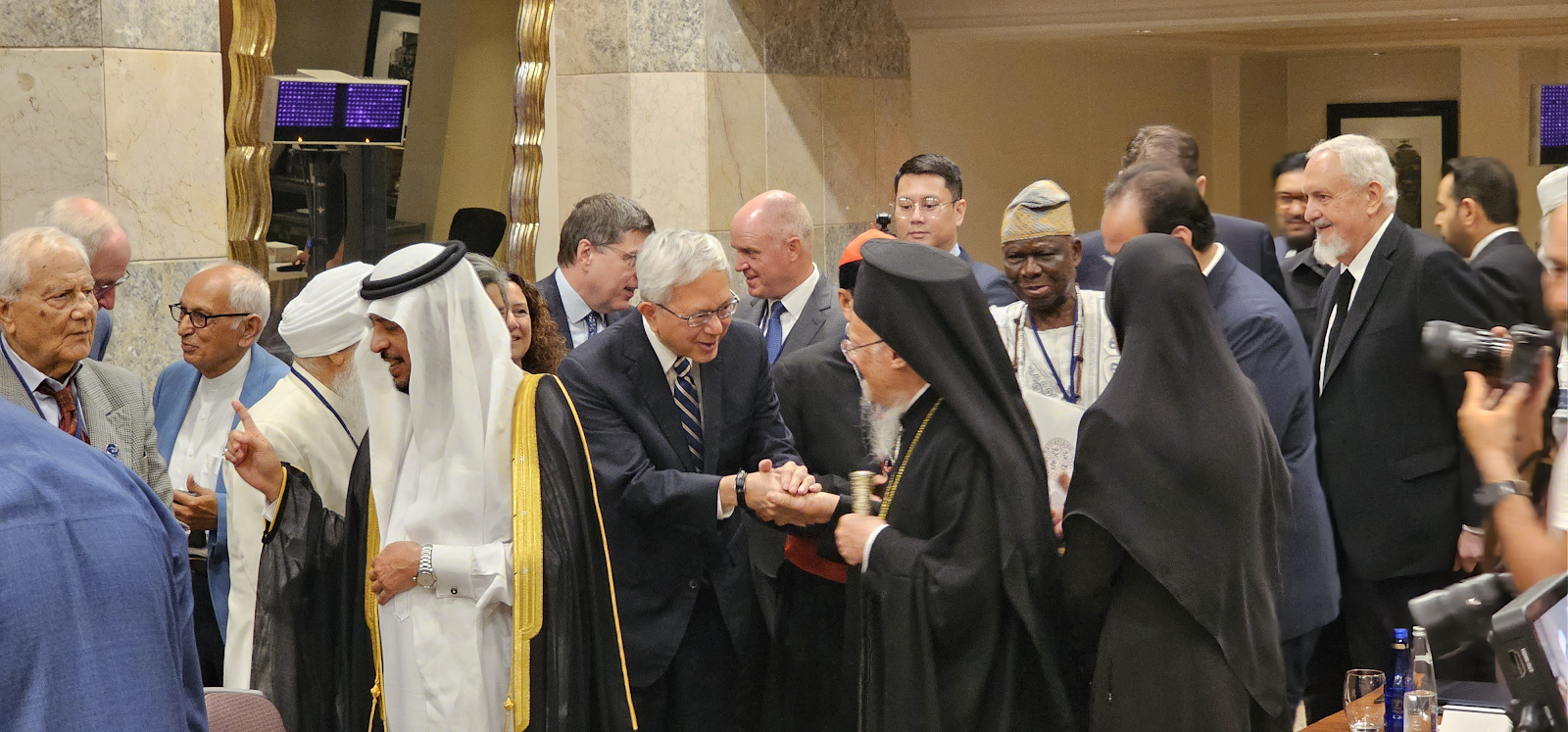
https://x.com/GerritWGong/status/1952006542880100854
In a sense, contention is inevitable and unavoidable because every individual is unique, and no two people agree on everything. Ideally, we...
https://x.com/GerritWGong/status/1952006542880100854
Faith leaders and communities have served on the frontlines of every major challenge the world has ever faced – Religions for Peace brings this expertise and commitment together for interfaith solutions that include government, civil society, and all other stakeholders.
Ten World Assemblies
Every five to seven years, Religions for Peace convenes a World Assembly to bring together faith leaders with government and civil society partners to forge a consensus on global priorities for peace and elect new leadership.
Previous World Assemblies have taken place in 2019 (Lindau, Germany), 2013 (Vienna, Austria), 2006 (Kyoto, Japan), 1999 (Amman, Jordan), 1994 (The Vatican, Italy), 1989 (Melbourne, Australia), 1984 (Nairobi, Kenya), 1979 (Princeton, United States), 1974 (Leuven, Belgium), and 1970 (Kyoto, Japan).
https://www.rfp.org/leadership/
_____
At the 2025 meeting, Elder Gerrit Gong participated in a panel discussion.
https://x.com/GerritWGong/status/1950317001714630988
Our faith traditions inspire us to be changemakers where conflict, mass displacement, poverty, violent extremism and inequality call for common action
Equality for women and girls is a foundation for securing a more peaceful and inclusive world for all people.
Recognising the intimate connection between all forms of life and communities, we are committed to nurturing a sustainable environment.
Everyone has the right to freedom of thought, conscience and religion. We bring faith communities together to champion this right for all.
Understanding diverse traditions is vital to increasing trust, respect, and cooperation among all people and faiths.
Strong partnerships with governments, civil society, and faith-based organisations ensures that our work is effective and leaves no one behind.
In a Father’s Day social media post on Sunday June 15, 2025, President Russel M. Nelson of The Church of Jesus Christ of Latter-day Saints expressed gratitude for peacemakers.
“I’ve spoken recently about the need for peacemakers. On this Father’s Day I feel gratitude for all the fathers who act as peacemakers in their homes and communities,” President Nelson said. “My own father was an example of this during my childhood. And I have tried my very best to carry over his righteous influence into my own family, which now includes hundreds of people—each of whom I love dearly!”
In his Father’s Day message, President Nelson issued a promise to fathers around the world.
“Fathers, as you become peacemakers in your homes, you can literally thwart the influence of the adversary,” he said. “As you demonstrate the charity that true followers of Jesus Christ manifest, the Lord will magnify your efforts beyond your loftiest imagination.
“As you follow the Prince of Peace, you will become His peacemakers.”
Recently I had an extended conversation about an issue in Church history that involves a combination of facts and assumptions, inferences, theories, and hypotheses.
By using the FAITH model of analysis, it is easy for everyone to agree on the actual facts, once they are separated from and distinguished from the assumptions, inferences, etc.
But this other individual framed the conversation in legal terms such as "burden of proof" and other references to judicial proceedings.
That is such an antiquated way of thinking I was a little surprised. But then I suppose most people are still in the mode of arguing about such things.
Arguing involves low-level consciousness.
In my career as a lawyer, I observed uncountable arguments, many about things that don't matter much. Basic human psychology makes people possessive about their things and their beliefs. In the academic world, I've been continually surprised at how closely scholars identify with their own theories. Some of them take confirmation bias to a level I didn't think possible.
Many people are also insecure, to the point where they seek validation from others. This is a major cause of contention. People think they need others to agree with them about their own beliefs and worldviews.
Returning to the legal framing, the individual I was conversing with seemed to think we were adversaries in some way. It was weird, actually. I explained that all I cared about was getting as many facts as are available, which I had assumed he wanted as well.
But he didn't.
He had a narrative he liked and he wanted to retain it. He was uninterested in facts that contradicted his narrative.
My general rule is that more facts are better than fewer facts. It's so strange when others disagree.
Some of the confusion about facts may arise from the term "fact-finder" or "finder of fact" that is often applied to a jury (or a judge if no jury). It's a misnomer, of course; no one know what actually happened in the past. The best we can do is make assumptions and inferences on a limited set of actual facts.
But maybe the idea of a jury/judge as a "fact-finder" has woven itself into social consciousness, to the point that people (especially those who participate in the judicial process) actually believe at some level that a jury/judge can find facts.
Again, weird.
This whole experience reminded me of the importance of the FAITH model to eliminate contention. But the FAITH model apparently threatens people who prefer to confirm their biases and worldviews by deeming their own assumptions and inferences and theories as facts.
Fun lesson!
_____
Here's a graphic that depicts the outcome of clarity, charity and understanding, as opposed to arguing and contention.
So many of us make a great fuss of matters of small consequence. We are so easily offended. Happy is the man who can brush aside the offending remarks of another and go on his way.
-Gordon B. HinckleyElder Uchtdorf gave a wonderful talk about unity on April 5, 2025, in General Conference. Here is a summary.
A friend visiting a branch in Germany was impressed by the members’ love for each other.
When people experience the Church for the first time, they are likely to notice how they feel and how members treat each other. The Savior wants them to leave with stronger faith in Him. The love felt there will lift them closer to Jesus Christ.
The Lord invites His children to join His kingdom and anxiously engage in building it. To be of one heart, individuals must align their heart with the Savior.
One category comes before all others: child of God. Unity in the Church is not because of a common background but because of a common objective — being “one in Christ.”
Those who love God and want to know Him better and seek to keep the commandments are a perfect fit for the Church, which is one body. “All are needed in the body of Christ.”
For those who are not yet members of the Church, “we invite you to join us as we rejoice in the Savior’s ‘song of redeeming love.‘”
Church members’ love for God and His children is a powerful testimony to the world that this is the Savior’s Church.
“The Lord invites us not just to join His kingdom but also to be anxiously engaged in building it.”
“We are one, not because of where we’ve been but where we are striving to go, not because of who we are but who we seek to become.”
“Our love for God and His children is a powerful testimony to the world that this is truly the Savior’s Church.”
Andy Kessler's article in the WSJ:
Excerpts:
there are calls from the media for civility. Now? We have a long history to overcome. Mark Twain, a 29-year-old San Francisco-based opinion columnist for a Nevada newspaper in 1865, was spewing venom, saying of the police, “Wax figures, besides being far more economical, would be about as useful.” Pianist and comedian Oscar Levant in 1940 said of his morning routine, “First I brush my teeth and then I sharpen my tongue.” Same.
Incivility became a favored tactic for activists. In 1971 Saul Alinsky wrote “Rules for Radicals,” which became the bible for the Obama and Biden administrations. Rule 5: “Ridicule is man’s most potent weapon.” Rule 13: “Pick the target, freeze it, personalize it, and polarize it.” Rude, but effective.
___
In 2017 the Washington Post cited Godwin’s Law: “As an online discussion continues, the probability of a reference or comparison to Hitler or Nazis approaches 1.” In 2016 the Post’s website ran this headline: “Don’t compare Donald Trump to Adolf Hitler. It belittles Hitler.”
_____
Is it over? Is society so depraved that life will never be civil again? In January, this paper quoted Jacob Mchangama, founder of Justitia, blaming cancel culture on “our species’ hard-wired tendencies toward tribalistic behavior and the self-righteous urge to punish outgroups who transgress taboos.”
Your taboo is my ballyhoo. Tribalism and self-righteousness are hard to combat, but not impossible. It has to start early and locally, in our education system and within our families and communities, to instill a sense of civility. Maybe someday.